Phra Mongkhon Bophit is one of the largest bronze Buddha images in Thailand.The Imange measures
9.55 metres at the widest point across the lap ,and 12.45 meters high without the base.this buddha
image is seated in the position of the subduing mara and situated on the west side of the old palace
compound in the Vihara of Phra Mongkhon Bophit temple.The image is belived to have been contructed in the
early Ayutthaya period between 1488 to 1602 A.D. and was originally situated at the east side of the olad palace
compound.Later ,during the region of King Song Tham it was moved to the west side and a Mondop was built to shelter it.
During the reign of King Phra Chao Sua (1706 A.D.) the top part of the Mondop and the head of the image were damaged by
lightnig.The Mondop was converted into a Vihara and the main restoration of Phra Mongkhon Bophit was completed during the
rein of King Boromakote (1742-1743 A.D.).
During the fall of thte Ayutthaya Kingdom in 1767 ,the roof of the Vihara was damaged by fire and the head and the right arm of
the image were broken.Later ,the image was repaired and the Vihara was completely retored again in 1956.
(source : information billboard ) Location : Phra Mongkhon Bophit
Wihan Phra Mongkhon Bophit ,Ayutthaya ,Thailand.
Go to destination : Wihan Phra Mongkhon Bophit
Arrival : Wihan Phra Mongkhon Bophit
(Date taken : Nov 16,2014)
Travelling Date : Dec18,2022
This is one place you should not miss to visit.Enjoy your trip.
The temple is inside the city wall.According to the stone inscripion of Wat Sorasak ,Nai Intra
Sorasak was grant a piece of land governor ,where he build a temple decicated to him.Ater construction was completed
,Vernerable Mahathen Thammatrailok from Dao Khon ,an uncleof the Sukhothai gorvernor ,was invited to reside as this temple.
in 1416 A.D. Somdet Chao Sam Phraya came as a yong boy with his mother and aunt to Sukhothai royalty was locates there. The main bell-shaped chedi sits on a base of elephant sculptures.This concept is based on a belief that the elephant regarded as
a beast of burden for the emperor ,is a suitable animal to firmly uphold Buddhism throughout a period of 5,000 years.
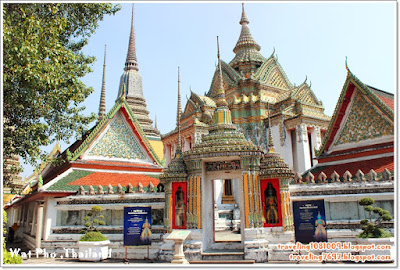
Wat Pho, the official name being Wat Phra Chetuphon Vimolmangklararm Rajwaramahaviharn, is the first grade royal monastery, regarded as the most important one during the reign of King Rama I of the Chakri Dynasty. The importance of this is due to the King having managed the restoration of Wat Phodharam, an old monastery from the Ayudhya period, and had it re-established as a the royal monastery located near the Grand Palace. Some ashes of King Rama I were also kept under the pedestal of the principal Buddha image known as Phra Buddha Theva Patimakorn in the main chapel.
The monastery is located in an area of 20 acres to the south of the Grand Palace, with Thai Wang road in the north, Sanam Chai road in the east, Setthakan road in the south and Maharat road in the west. Separated by a tall white wall on Chetuphon road, the monastery has two main quarters: the sacred or a chapel section, Buddhavas, and the residential or the monk's living section, Sangghavas.
It is said in a stone inscription that, after moving to the Grand Palace, King Phra Buddha Yod Fa The Great (King Rama I) recognized that there were 2 old temples along both sides of the Grand Palace: Wat Salak (Wat Mahatart) in the north, and Wat Phodharam in the south. He ordered his noblemen from the department of the Ten Crafts to restore Wat Phodharam in 1788. This first restoration took 7 years 5 months and 28 days. Then there was a celebration in 1801 and the Royal named it “Wat Phra Chetuphon Vimolmangklavas”, which was changed to “Wat Phra Chetuphon Vimolmangklararm”during the reign of King Rama IV. ( Ref.: www.watpho.com )
Go to Destination 2 Sanamchai Road, Grand Palace Subdistrict, Pranakorn District, Bangkok 10200
Arrival : Wat Pho
(Date taken : January 15,2015 and April 2,2016)
Wat Pho directory
Entrance 2 (Chetuphon Road)
Khao Mor and Hermit Statues ( No.5)
Phra Maha Chedi Si Rajakarn ( No.2)
Phra Maha Chedi Si Rajakarn, a group of four huge pagodas surrounded by white wall with Thai-Chinese style sheltered gates decorated with colour-glazed tiles and Chinese rockeries guardians.
Each pagoda is 42-metre high, twelve or added notched-rim structures ending in a tall spire and elaborated with colourful mosaics. The one with green tile mosaic named Phra Maha Chedi Sri Sanpetdayarn (No.1), constructed during the reign of King Rama I to cover the ruined image of Buddha ‘Phra Srisanpetch' where relics of Lord Buddha are kept, represents the reign of King Rama I. The ruined standing Buddha is 16-metre high and was brought from the Royal Palace in Ayudhya. Phra Maha Chedi Dilok Dhammakaroknitarn (No.2), the one with white-tile mosaic representing the reign of King Rama II, was built by his son, King Rama III.
He also built the yellow tile mosaic pagoda, Phra Maha Chedi Muni Batborikharn (No.3), for his own reign and for the praise of Buddha. The last one, in dark blue tile mosaic, represents the reign of King Rama IV or King Mongkut. It was built in the same style as Phra Maha Chedi Song Phra Srisuriyothai (No.4) of the Ayudhya period with the purpose of praise for the Lord Buddha. ( Ref.: www.watpho.com )
Phra Maha Chedi Sri Sanpetdayarn (No.1)
Phra Maha Chedi Dilok Dhammakaroknitarn (No.2)
Phra Maha Chedi Muni Batborikharn (No.3)
Phra Maha Chedi Song Phra Srisuriyothai (No.4)
Phra Buddha Saiyas ( No.4)
Phra Mondop ( No.3)
Wat Pho Giant ( No.6)
Phra Ubosot ( No.1)
This is one place you should not miss to visit ,enjoy.